
How to Calculate Excess Private Health Insurance Entitlement?
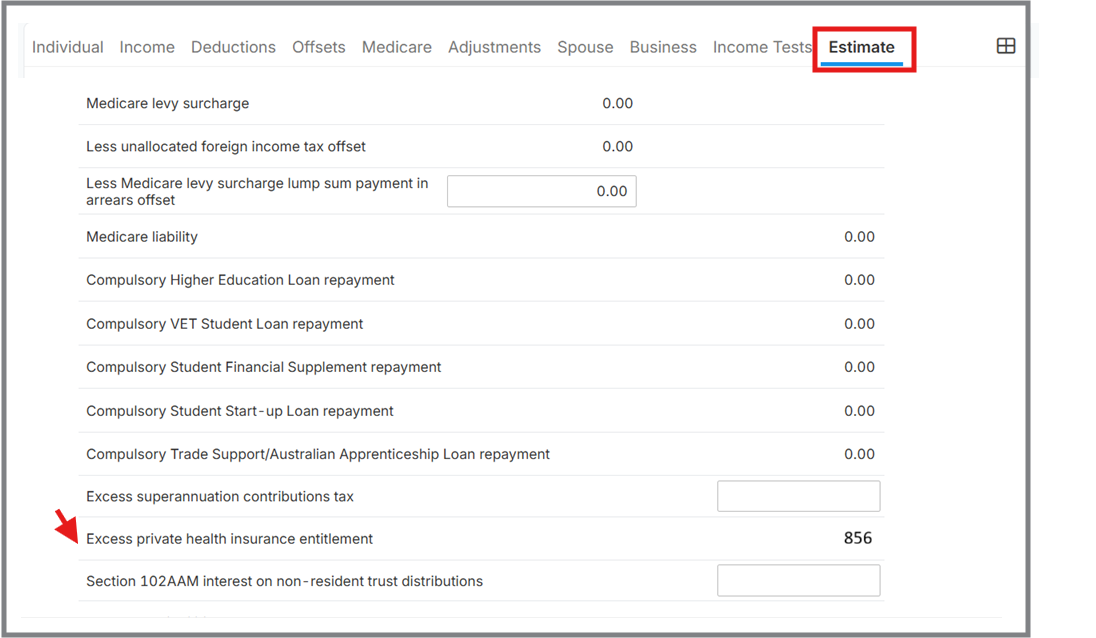
The excess private health insurance entitlement arises when a taxpayer or their spouse receives a Private Health Insurance (PHI) rebate but their combined income exceeds the threshold, making them ineligible for the rebate. The rebate amount must then be added back to their tax liability.
Illustration
Helen and Darryl received a PHI rebate of $1,391 during the year. However, their combined income exceeded the threshold of $317,501, meaning they were not entitled to the rebate. As a result, the full rebate amount of $1,391 was added back to their tax returns.
Helen and Darryl received a PHI rebate of $1,391 during the year. However, their combined income exceeded the threshold of $317,501, meaning they were not entitled to the rebate. As a result, the full rebate amount of $1,391 was added back to their tax returns.
Steps to Calculate Excess PHI Entitlement
1. Determine the PHI Rebate Received
- Locate the rebate amount received during the year. For example, Helen and Darryl received $1,391.
2. Check Combined Income Against Threshold
- Verify if the combined income exceeds the threshold for PHI rebate eligibility. For the year in question, the threshold is $317,501.
3. Add Back the Rebate
- If the combined income exceeds the threshold, the full rebate amount must be added back to the tax return as a liability.
4. Avoid Double Add-Back
- Ensure that the rebate is not added back twice. This can happen if PHI details for both the taxpayer and spouse are entered incorrectly or using the same code.
Correct Coding for PHI Details
To prevent errors:
- Use Code C for the taxpayer's PHI details.
- Use Code D for the spouse's PHI details.
- Enter these details in separate rows to ensure the system calculates the rebate correctly and avoids duplication.
Example of Correct Coding
Key Reminder
- The PHI rebate is assessed on family income, but it must be reported separately for the taxpayer and spouse using the correct PHI codes.
- Incorrect coding can result in the same rebate being added back multiple times.
Related ATO Reference
For official guidance, refer to the Australian Taxation Office (ATO) resources: